Posted on October 14, 2026 by Jasmine Yu
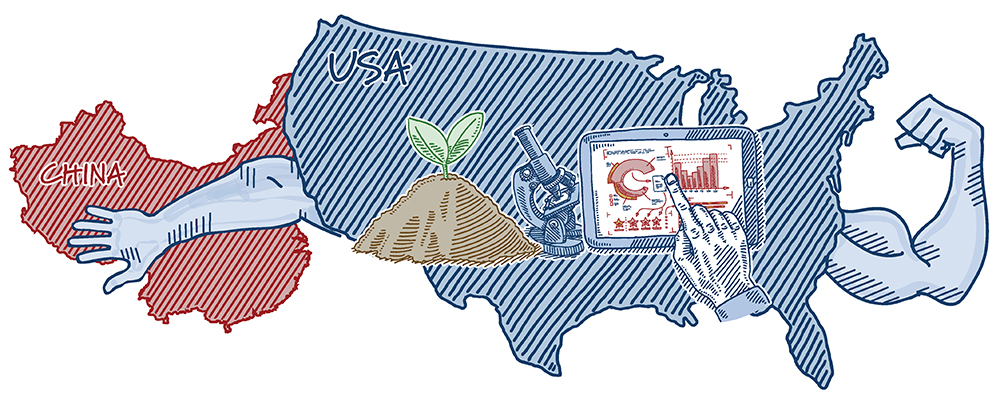
American agricultural data is a national security asset. The seed genetics, soil data, precision agriculture tools and germplasm libraries behind U.S. crop production reflect decades of research investment that keep American farmers productive, profitable and competitive in global markets.
For decades, the Chinese Communist Party (CCP) has stolen U.S. data, trade secrets and intellectual property across sectors. Agriculture is no exception. From proprietary seed genetics to agricultural algorithms and field-level data, China has targeted the information that gives American farmers an edge. If Congress doesn’t act, American agriculture could follow the same path as other American industries, such as pharmaceuticals, where the U.S. has become dependent on China for a product American industry used to lead in producing.
In 2016, a director at Chinese seed company DBN Group, was sentenced to prison for physically digging up proprietary corn seed from DuPont Pioneer and Monsanto fields in Iowa and Illinois to ship back to China, a federal crime. Another example, in 2017, a scientist at Monsanto’s Climate Corporation stole the source code for a predictive algorithm using satellite and soil data that guides farmers’ planting decisions and took it to China’s Institute of Soil Science. He was convicted of conspiracy to commit economic espionage.
Those are just the criminal cases. Chinese-manufactured agricultural drones now dominate the U.S. spray-drone market and can transmit high-resolution crop and field data back through Chinese servers. Information, like predicted agricultural yields, can give China an advantage in global commodities trading and put U.S. food security at risk. The administration and members of Congress have raised the alarm, but the collection of agricultural data continues.
The pharmaceutical sector offers a warning. This year, the House Select Committee on the Chinese Communist Party (CCP) documented how China established a dominant position over the U.S. drug supply: 1) copy the technology, 2) subsidize production beyond domestic need, then 3) undercut American manufacturers on price until they can’t compete. The U.S. is now dependent on China for essential medicines, controlling the key starting materials for 94 percent of amoxicillin and 70 percent of acetaminophen.
The CCP is running the same strategy on seeds. China’s 2021 Seed Industry Revitalization Plan, explicitly called seeds “the microchips of agriculture.” The CCP has since approved 64 genetically modified corn varieties and organized state-backed companies to build seed capacity that already exceeds domestic demand. That is the same overcapacity strategy that preceded China’s dominance in the U.S. pharmaceutical supply.
For farmers operating on thin margins, better agricultural data can translate into greater productivity and lower costs. Plant genetic data helps researchers develop higher-yielding and more resilient crop varieties. Soil and microbial genetics data can produce more efficient on-farm inputs. Additionally, precision agriculture built on American field data helps farmers apply the right inputs, in the right amounts, at the right time, cutting waste and improving returns per acre. Together, these technologies represent a significant part of America’s agricultural advantage.
But the same data that makes American agriculture more productive can also help competitors close the gap. As China expands its ability to collect and analyze agricultural data, it can accelerate its own innovation while benefiting from knowledge generated through decades of American investment.
The risk extends beyond the research pipeline. The CCP is actively monitoring U.S. crop production through its own satellite systems and collecting field-level data through commercial drones operating on American farms. This data could be used to time commodity purchases and gain leverage in trade and larger international negotiations.
America’s agricultural research advantage took decades to build. Bringing a single new crop variety to market can take 8 to 10 years. Behind every improved seed is years of research, field testing, data collection and investment.
That is why protecting agricultural intellectual property and data is critical. China is not building that pipeline from scratch, it is trying to take what American researchers have already built and use it to undercut American producers in global markets. Losing this research race does not just cost American agriculture its competitive edge. It costs American farmers their markets. We should not allow China to turn stolen American innovation into a competitive advantage against American farmers in global markets.
The Trump Administration is acting. Through the Genesis Mission and the Agriculture Advanced Research and Development Authority (AgARDA), USDA has launched an Agricultural National Science and Technology Challenge, bringing together experts to build new AI infrastructure that can pull together disparate data sets, including images, field data and lab results, so researchers can improve identification of plant and seed traits to develop better crops for American farmers.
USDA is also upgrading its data foundation. In September, Secretary Rollins unveiled the USDA Data Modernization Plan to modernize USDA’s agricultural data collection and expand satellite-based yield monitoring. This month, USDA announced an $180 million investment to launch the Seed Sovereignty Initiative, which will sequence collections of major crops within USDA’s Agricultural Research Service (ARS) National Plant Germplasm System (NPGS), unlocking a key resource to strengthen U.S. agricultural security.
Congress can build on the Administration’s work by funding agricultural research through AgARDA and USDA’s data modernization with sustained, multi-year appropriations. The U.S. needs to keep generating better science, better technology and better data faster than its competitors. This funding would allow the U.S. to better compete with the build-out of China’s agricultural data infrastructure.
American agriculture leads the world in productivity and has dramatically decoupled output from emissions, producing over 50% more, while growing emissions by only 7% since 1990, an advantage built directly on the innovation and data China is working to take. Ceding that leadership costs American farmers market share and hands China control over the world’s seed technology and food supply.
America spent generations building the world’s most innovative agricultural system. Congress should protect the data and intellectual property behind it and make sure American farmers have the research and technology they need to stay ahead.