Posted on November 10, 2026 by Rafae Ghani and Matthew Mailloux
As the world enters an era of intensified geopolitical competition, U.S. national security and economic competitiveness will hinge on continued U.S. leadership of cutting-edge energy and industrial technologies. The Department of Energy has a unique innovation powerhouse to commercialize novel energy technologies: the Advanced Research Projects Agency – Energy (ARPA-E). In an era of rising prices, global competition and surging demand, there’s no reason to keep the powder dry in an administration focused on energy dominance: it’s time for DOE to scale up the SCALEUP program.
ARPA-E plays a key role in advancing U.S. energy leadership by providing a critical bridge across the valley of death that hinders countless energy innovation startups. Since Congressional authorization over two decades ago, ARPA-E’s mission has been to catalyze emerging technologies from the lab to private sector investment, turning promising new technologies into real gains in energy production and energy security. In total, ARPA-E has provided more than $4.4 billion to over 1,850 projects that have resulted in the formation of at least 173 new U.S. companies and 41 “exits” at market valuations worth $32.6 billion through mergers, acquisitions and IPOs. These exits include promising technologies that can underpin the next generation of American energy dominance, including enhanced geothermal company Fervo Energy, long-duration energy storage leader Form Energy, and fusion front-runner Commonwealth Fusion Systems. All in all, ARPA-E’s funding outcomes represent an 8x return on taxpayer dollars, underscoring the importance of fueling American innovation at the earliest stages of new technologies.
In October, ARPA-E released its latest funding opportunity, the Unlocking New Levels of Output and Capacity for Key Subsurface Resources (UNLOCK) program, which will support breakthrough subsurface technologies with applications for oil, gas, geothermal and critical minerals resources. The continued support of new projects keeps the ARPA-E project pipeline fully loaded, with more opportunities for follow-on funding for successful projects.
ARPA-E’s authorities have grown to prioritize commercial applications, including a major shift in 2020 that formalized the Seeding Critical Advances for Leading Energy Technologies with Untapped Potential (SCALEUP) program in the Energy Act of 2020. SCALEUP is a key program designed to award up to $20 million in follow-on funding to successful ARPA-E awardees that have achieved a commercialization milestone.
In 2024, ARPA-E further refined the structure by launching SCALEUP Ready, a rolling, more flexible funding opportunity, as opposed to the time-limited windows available in 2019, 2021 and 2023. In the years since, this program has maintained the competitive nature of these awards for successful projects while avoiding unnecessary delays in making these follow-on funds available. ARPA-E announced its first selectees as part of the revamped program in April, pledging up to $40 million to support Deep Isolation’s nuclear fuel cycle technology and Lithios’s electrochemical Advanced Lithium Extraction technology.

This program fills a key gap in the “missing middle” of the innovation curve that can “resolve technical or commercial uncertainties” to unlock the next wave of private investment. These award recipients have a strong track record to show for it too, with multiple SCALEUP recipients later advancing into demonstration projects or pursuing commercial applications.
Over the past two decades, Congress has been the most consistent champion of ARPA-E and its capabilities. Despite wide-ranging swings in different Presidents’ budget requests, Congress has enacted relatively stable funding for ARPA-E every single year of its existence. This stability has given ARPA-E a reliable funding pool to support cutting-edge energy technologies.
ARPA-E Budget: Request vs. Enacted, FY2017-FY2026
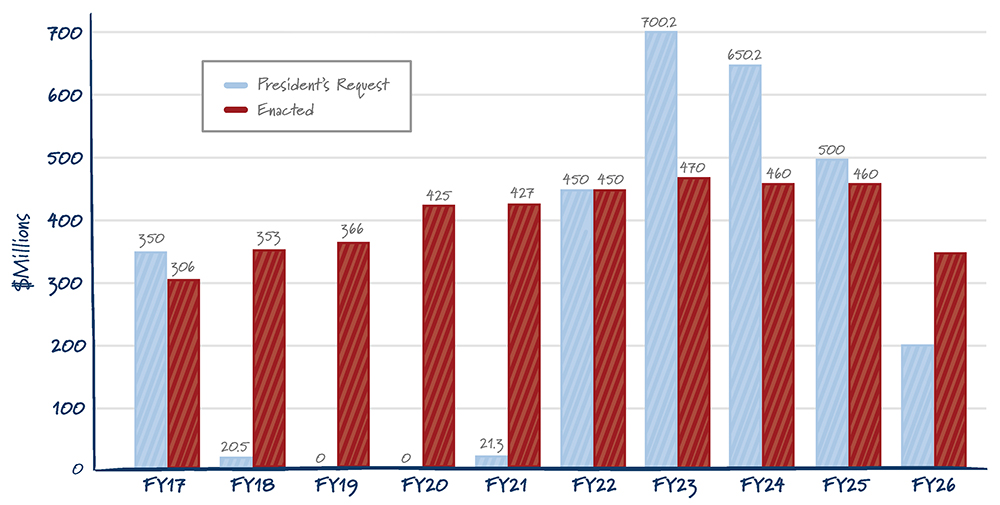
Source: Annual Appropriations bills and President’s Budget Requests
This consistent Congressional support has provided ARPA-E with budgetary resources totaling nearly $1.2B, including more than $700 million in unobligated funds. In the most recently enacted appropriations bill for FY26, Congress made its intent clear, encouraging ARPA-E to commit robust funding for the SCALEUP program. In a recent report on the future of ARPA-E, the National Academies agreed, finding that increasing the SCALEUP program budget with an additional $80 million annually could support the commercialization needs of an additional 6-10 energy projects each year.
ARPA-E Budget Snapshot FY2017 to present
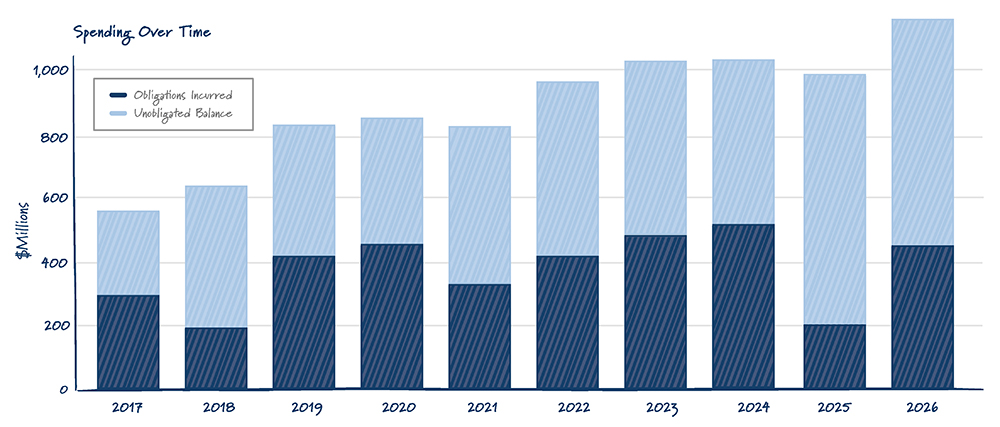
ARPA-E’s budget resources have steadily accrued over the past decade.
Source: USA Spending data
Just as the second Trump administration has repurposed DOE’s loan authorities in service of energy dominance, there is an opportunity, using existing resources, for ARPA-E to evolve from an agency focused purely on breakthrough invention into one that actively shepherds those breakthroughs across the valley of death. To achieve this, ARPA-E should increase the amount of funds dedicated to the SCALEUP Ready program from $50 million per fiscal year stated in the SCALEUP Ready Notice of Funding Opportunity to a significantly higher level of annual funding. As the National Academies report recommended, an additional $80 million in annual SCALEUP project funding would go a long way to accelerate these types of projects.
The missing middle is illustrated by ARPA-E’s own success stories, proving that ARPA-E has a knack for identifying early-stage technologies way earlier than Wall Street. For example, Fervo Energy secured its first DOE award in 2018. ARPA-E soon followed with a second award in 2019 and another in 2022. It then took another 7 years for Fervo to make its public market debut after several highly successful funding rounds. ARPA-E can materially shorten the time promising technologies require to earn investor approval and accelerate their path to market. Focusing ARPA-E’s efforts on accelerated timelines would align with recent proposals for the agency to think in terms of “building industries that scale,” rather than technologies in isolation. More tangibly, ARPA-E should measure success by – and report to Congress on – the length of time from an initial award to a commercial deployment.
ARPA-E’s long list of alumni companies and awardees are ready to bring their technologies to market to meet rising demand and address rising costs. ARPA-E has a proven record. Congress and DOE have built an innovation engine that delivers. Now it is time to scale up.