Posted on May 28, 2026 by Will Bryant , Casey Kelly and Jake Kunzler
This summer, Governors will have a unique opportunity to bolster clean, firm energy deployment in their states through Opportunity Zone designations. Selected strategically, these designations can overlap in areas eligible for additional clean energy tax incentives, improving the economics of advanced nuclear and geothermal projects. The result would be more investment in clean, reliable power that can drive economic growth and grid reliability for decades to come. Multiple federal tax credits can now be utilized in an Opportunity Zone to amplify their impact.
Opportunity Zones are a bipartisan policy first championed by Senators Tim Scott (R-SC) and Cory Booker (D-NJ) that provide tax incentives for investments made in economically distressed census tracts. The 2025 Working Families Tax Cuts built on the 2017 Tax Cuts and Jobs Act by making Opportunity Zones a permanent part of the tax code. Starting in July 2026, Governors have 90 days to determine which of their state’s eligible census tracts will receive this designation. The choices will last a decade and create durable signals for investors.
The Working Families Tax Cuts also preserved and strengthened Section 48E investment and Section 45Y production clean energy tax credits, reflecting a Republican commitment to supporting innovative, dispatchable clean technologies such as advanced nuclear and geothermal. Built into those credits are two place-based bonuses that direct investment toward communities with existing energy infrastructure and workforce capacity. First, the Energy Community bonus adds 10% to the tax credit value for projects located in areas with significant fossil fuel employment and above-average unemployment, near retired coal mines or coal-fired power plants, or on brownfield sites. These are regions where new clean energy development can build on existing grid connections, skilled labor, and industrial land. Second, the new Nuclear Energy Community designation under the 45Y production tax credit adds an additional 10% to advanced nuclear projects in metropolitan areas with established nuclear workforces and supply chains.
Taken together, these three federal incentives, including Opportunity Zones, the Energy Community adder, and the Nuclear Community adder, can now be jointly utilized on a single site. Based on published IRS data and ClearPath’s internal analysis, thousands of census tracts are likely to qualify for all three, but only if Governors take action this summer. These tracts deserve close attention from developers, investors, and state energy offices ahead of the July designation window. Here’s how the three incentives compare:
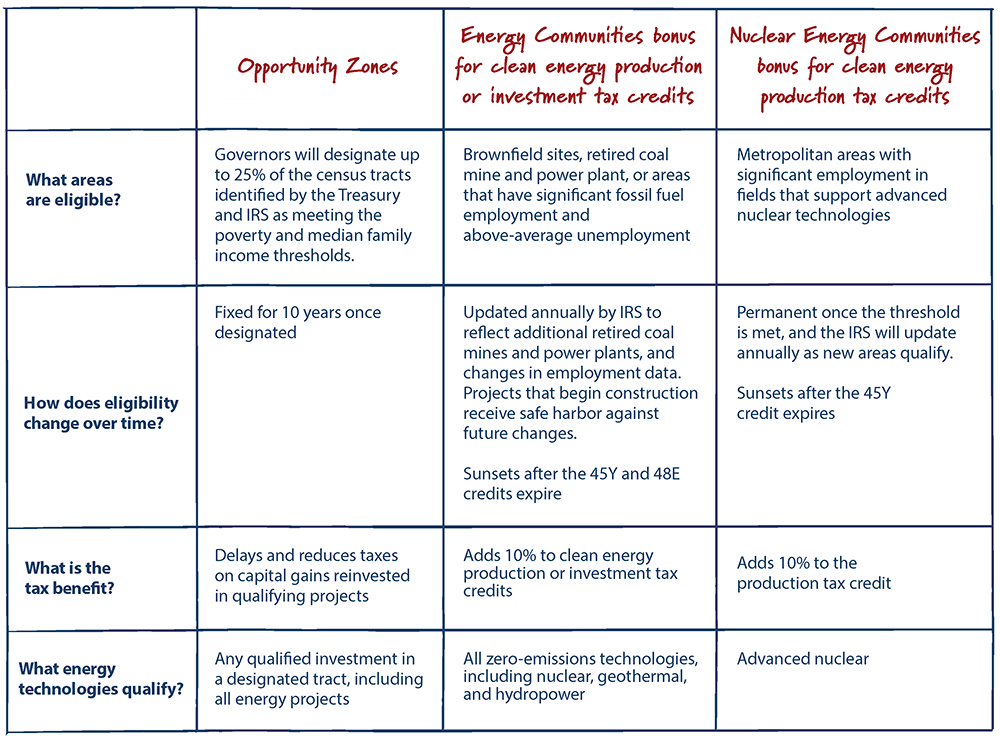
Each incentive reduces the cost of a new nuclear project in a different way. Opportunity Zones make it cheaper to attract private investment, as investors who put capital gains into a qualifying project can defer and reduce the taxes they owe on those gains, making the investment more attractive compared to alternatives outside Opportunity Zones. The Energy Community bonus directly increases the tax credit value of each megawatt-hour produced or dollar invested in a new energy project, while the Nuclear Energy Community bonus increases the tax credit value of each megawatt-hour produced by advanced nuclear energy projects. When all three apply to a census tract, they combine to meaningfully reduce the cost of capital for advanced nuclear, one of the most significant barriers to building American nuclear power.
Our analysis finds that 3,662 census tracts across 32 states may qualify for all three credits. These locations are found in the Rust Belt, the Tennessee Valley, the Carolinas, the Western Gulf Coast, and pockets of Southern California. These locations have the construction trades, fuel cycle facilities, research and development facilities, and a manufacturing base for advanced nuclear in addition to a broader history and growing presence of energy-centric industries. Opportunity Zone designations this summer create the rare opportunity to utilize three federal tax benefits on the same site.
We also pulled the broader overlays: tracts where Opportunity Zone eligibility intersects with the Energy Community Bonus alone, 8,401 tracts in 46 states relevant to all types of clean energy projects, and with the Nuclear Energy Community designation alone, 10,782 tracts in 40 states with advanced nuclear-ready metros. Together, the layers show Governors where their designations can do double or triple duty, driving private investment in reliable, dispatchable clean energy projects like advanced nuclear and geothermal that strengthen both local economies and grid reliability.
Demand growth from emerging industries like AI and the revitalization of manufacturing represents a generational opportunity to bring economic development to communities across the country. Governors have 90 days, starting July 1, to designate Opportunity Zones that spur the development of clean, dispatchable power in their states. The map shows where to start.
Sources
Opportunity Zones
Census tracts eligible for designation as an Opportunity Zone must meet income and poverty-level criteria calculated from the American Community Survey. The most recent data was published in 2026, and the 2026 Opportunity Zone designations are available here.
Energy Communities
Census tracts that qualify for this bonus due to a coal closure do not change year-to-year, except when new coal plants close. Census tracts that qualify on the basis of employment (whether in the fossil industry or the overall employment level) change yearly, and the Treasury Department publishes new files as data becomes available. Both datasets are available here. Census tracts with brownfield sites would also qualify for this bonus, but we do not include them here because the majority of qualifying brownfields sites are not registered in EPA’s database.
Nuclear Energy Communities
Treasury has not yet released guidance on the Nuclear Energy Communities, so the eligible regions shown above reflect ClearPath’s interpretation and analysis of authorizing language in the 2025 Working Families Tax Cuts Act. We used developer profiles from the Gateway for Advanced Innovation in Nuclear (GAIN) and supply chain data from the Nuclear Regulatory Commission (NRC) and the American Society of Mechanical Engineers (ASME) to identify the universe of companies and facilities that could meet the qualification requirements for a Nuclear Energy Community. Due to poor data, we were unable to estimate employment levels at these companies and facilities as would be required by the authorizing language. The regions shown on the map should be interpreted as MSAs that could potentially qualify for the Nuclear Energy Communities bonus, pending further data collection and Treasury guidance.