Posted on June 4, 2026 by Justin Williams and Emily Johnson
Energy security doesn’t just power economies; it defines alliances. Few nations understand this better than Japan. With scarce domestic resources and deep import dependence, the country knows firsthand how vulnerable it is to global supply shocks, making energy security a national imperative. ClearPath’s educational series, the Clean Energy Innovation Academy (CEIA), took nine U.S. Senate Republican staff to Japan to see that commitment firsthand. At every stop, the case for American energy leadership was clear and demonstrated why the United States must innovate fast, build here and sell globally.

U.S. Senate Staff pictured with U.S. Ambassador to Japan George Glass. [L-R]: Micah Chambers, Dan Horning, Lucas Da Pieve, Chris Prandoni, Wendy Baig, Jake McCurdy, Ambassador Glass, Joshua Sizemore, Jeremy Harrell, Duncan Rankin, Alicia Badley
American LNG is essential for Japan: American liquefied natural gas (LNG) is a critical piece of Japan’s energy mix, and American technology is woven throughout Japan’s energy systems. Standing inside JERA Futtsu Thermal Power station, one of Japan’s largest natural gas power plants, the scale of U.S. involvement was on full display. GE Vernova turbines manufactured in Greenville, South Carolina, drive the bulk of the more than 5,000 megawatts powering the Tokyo metropolitan area. The fuel feeding those turbines is increasingly American, too. The U.S. currently supplies roughly 10 percent of Japan’s total LNG imports, and with U.S. export capacity projected to nearly double by 2031, the U.S. is well-positioned to expand that share. As Japan continues to prioritize energy security and diversify its supply base, the U.S. is a natural partner, offering LNG that is reliable, affordable and strategically aligned with the interests of both nations.
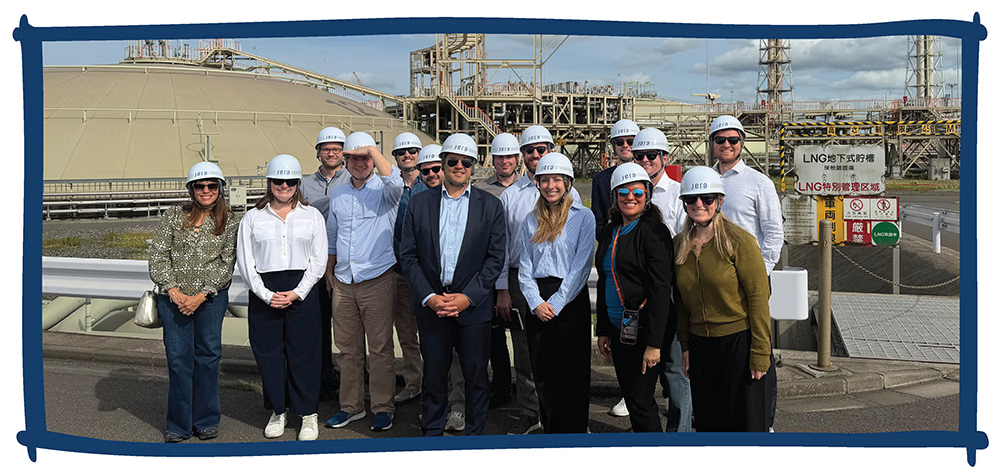
he ClearPath team and U.S. Senate staff pictured at the JERA Futtsu Thermal Power Station.
Japan is backing American energy: Japan has committed $550 billion in investment into U.S. strategic industries, with roughly $300 billion directed toward energy, including LNG, grid modernization and nuclear development. Conversations with senior officials across the Ministry of Economy, Trade and Industry (METI), Ministry of Foreign Affairs (MOFA) and Ministry of Environment (MOE) reinforced that this capital flows here because our allies trust American reliability and see the U.S. as their partner of choice on energy. The energy policy decisions in Washington, D.C. carry weight far beyond U.S. borders.
Nuclear fuel independence is a long-term investment: The Rokkasho Nuclear Fuel Complex, operated by Japan Nuclear Fuel Limited, is one of the most significant energy infrastructure projects in the world, bringing together uranium enrichment, spent fuel reprocessing, mixed oxide (MOX) fuel fabrication and low-level waste management in a single facility. It represents Japan’s commitment to a closed nuclear fuel cycle and taking control of its own energy future. Japan has no domestic uranium, yet rather than remain vulnerable to the geopolitical risks of import dependence, the country has spent decades building the industrial capacity to maximize and reuse what it imports. The U.S. has the potential to pursue a similar path, with growing investments in domestic uranium enrichment and used fuel management pointing toward long-term nuclear energy independence. Rokkasho paints a vivid picture of what that long-term commitment looks like in practice.

The ClearPath team and U.S. Senate staff pictured at the Rokkasho Nuclear Fuel Complex.
Nuclear power is making a comeback in Japan: Fukushima Daiichi has defined Japan’s energy story for over a decade. In the aftermath of the 2011 disaster, Japan stepped back from nuclear power, but the economic and energy security costs of that decision proved too significant to sustain. Today, Japan is recommitting to nuclear as an essential part of its energy future, and its partnership with the U.S. is central to that effort. American nuclear technology, expertise and regulatory standards have long set the global benchmark, and the opportunity to deepen that leadership has never been greater.
Strategic export financing drives energy leadership: Japan has modernized its export and investment financing to prioritize strategic sectors, with energy and supply chain resilience at the core of that effort. The Japan Bank for International Cooperation (JBIC) plays a central role in financing and facilitating those investments, helping to move strategic projects from ambition to reality. That enhanced capacity makes JBIC the tip of the spear in driving the investment deals that underpin the broader U.S.-Japan Strategic Investment Initiative. The upcoming reauthorization of the Export-Import Bank (EXIM) presents a critical opportunity for the U.S. to take a more strategic approach to its own export financing. Done right, it creates the flexibility American energy projects need to compete and win in global markets.
U.S.-Japan industry partnerships are delivering real results: Mitsubishi Heavy Industries, Ltd. (MHI) exemplifies what U.S.-Japan private sector collaboration looks like at its best. As AI data centers and industrial expansion drive electricity demand, innovation and industrial competitiveness have become shared priorities for both nations. MHI’s carbon capture technology is deployed globally, including at the Petra Nova project in Texas, and MHI has invested in Fervo Energy, a U.S.-based enhanced geothermal startup, signaling a shared interest in geothermal as a critical baseload resource. These are not one-sided arrangements; they are cutting-edge technologies developed through a partnership that creates value for both countries. With American electricity demand projected to grow 35 to 50 percent by 2040, every reliable and affordable baseload source matters, and U.S.-Japan industry partnerships are well-positioned to deliver at the scale the moment demands.
Japan invested deliberately in technology, alliances and industrial capacity to secure its energy future – a remarkable achievement for a nation with scarce domestic resources. The U.S. has every advantage Japan lacks: abundant natural gas, uranium reserves and geothermal potential, backed by a private sector that consistently leads the world in energy innovation.
What emerged is a partnership built on mutual interest. Japan is investing to scale technologies in both countries while the U.S. is well positioned to be the world’s energy solutions provider; the demand is real, and the opportunity to innovate fast, build here and sell globally has never been greater.