Posted on May 13, 2026 by Kelsey Grant
In 2016, the United States exported its first cargo of liquefied natural gas (LNG) produced from the lower 48 states – marking the start of America’s rise as a major global LNG supplier. The U.S. is the world’s largest LNG exporter since 2022, cementing America’s role as a reliable energy supplier to allies and trading partners across the globe.
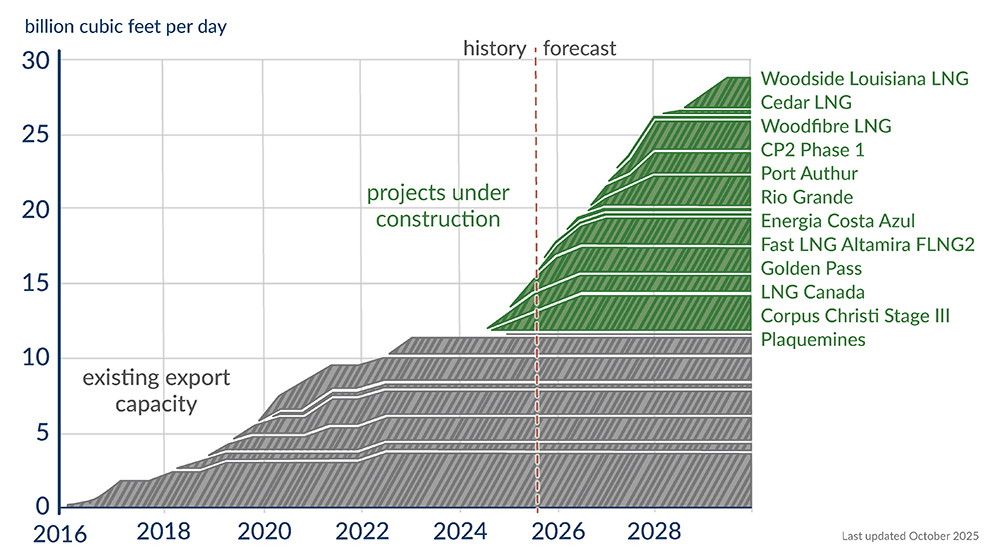
The next chapter of U.S. leadership is already underway. Developers plan to more than double U.S. liquefaction capacity, adding an estimated 13.9 billion cubic feet of natural gas per day (Bcf/d) between 2025 and 2029, with additional projects planned and under construction.
America’s LNG leadership strengthens national security, supports high-paying jobs at home and expands markets for abundant U.S. natural gas. LNG can also help lower global emissions in certain markets by providing a reliable alternative to more carbon-intensive fuels, particularly in fast-growing economies where energy demand continues to rise. As global demand for affordable and dependable power increases, LNG offers a practical pathway to advance energy security and support global emission reductions.
North America Liquefied Natural Gas Export Capacity By Projects (2016-2029)
LNG is natural gas in liquid form. Natural gas is cooled to approximately -260°F and compressed until it becomes a liquid. This process reduces the fuel’s volume by roughly 600 times, making it far more efficient to store and transport over long distances across the ocean. Once delivered to its destination, LNG is warmed back into a gaseous state and used for electricity generation, manufacturing, heating and other industrial purposes.
America’s LNG strength is rooted in an unmatched domestic resource base. Fueled by the shale revolution and advances in horizontal drilling and hydraulic fracturing, the U.S. now produces roughly one-quarter of the world’s natural gas – surpassing Russia in 2009. This abundant supply has enabled the U.S. to scale LNG exports while continuing to meet growing domestic demand.
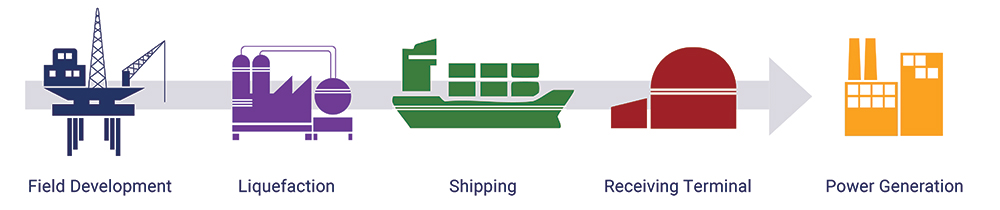
The LNG value chain is a fully integrated system that moves American natural gas from domestic production fields to consumers around the world. It includes natural gas production, pipeline transportation, liquefaction, shipping, regasification and end use, delivering reliable energy for power generation, heating and manufacturing.
LNG Transport Cycle
LNG delivers tangible benefits for the U.S. and its allies – strengthening energy security, driving economic growth, creating jobs, supporting reliable power and helping lower global emissions
1. Global Energy Security and U.S. Energy Leadership – LNG is a cornerstone of American energy security and geopolitical leadership. Global demand for natural gas and LNG is expected to remain strong for decades as countries seek affordable, clean and reliable energy sources. Natural gas demand is projected to increase by 20% through 2035 and continue rising through 2050, and the global LNG market will grow from approximately 560 bcm in 2024 to 880 bcm in 2035 and more than 1,020 bcm by 2050. Much of this growth will be driven by power generation and heavy industry, particularly in emerging markets experiencing rapid industrialization and economic growth.
U.S. LNG exports have already helped Europe reduce dependence on Russian gas supplies following Russia’s invasion of Ukraine. In Asia, U.S. LNG can strengthen the energy security of key allies such as Japan while offering growing economies an alternative to less reliable suppliers. During periods of geopolitical instability and supply disruption, access to reliable U.S. LNG helps allies maintain affordable energy supplies, economic stability and energy security.
2. Economic Growth and U.S. Jobs – LNG is a major driver of American economic growth and high-quality jobs across the country. Since 2016, the U.S. LNG industry has contributed $400 billion to U.S. GDP and supported hundreds of thousands of high-quality American jobs. U.S. LNG exports are now projected to support an annual average of 495,000 jobs and generate $1.3 trillion in U.S. GDP through 2040. Importantly, 37% of those jobs and 30% of GDP benefits are expected to occur in non-natural gas-producing states, underscoring LNG’s broad economic benefits. From natural gas production and pipeline construction to export terminals, manufacturing, engineering and port activity, LNG strengthens local economies across the U.S.
3. National Security – Energy security is national security. Our adversaries weaponize it and our allies understand their acute vulnerabilities, especially following recent supply disruptions amid wars in Ukraine and Iran. U.S. LNG exports enhance America’s geopolitical leverage by helping allies diversify supply, reducing the influence of hostile countries and creating long-term commercial partnerships that bolster broader diplomatic and security relationships. The Trump Administration has taken steps to bring new LNG capacity online, including through support of large capital projects like the Alaska LNG Pipeline, which DOE Secretary Wright recently noted as his number one infrastructure priority.
American LNG Producers Are Some of the Cleanest in the World
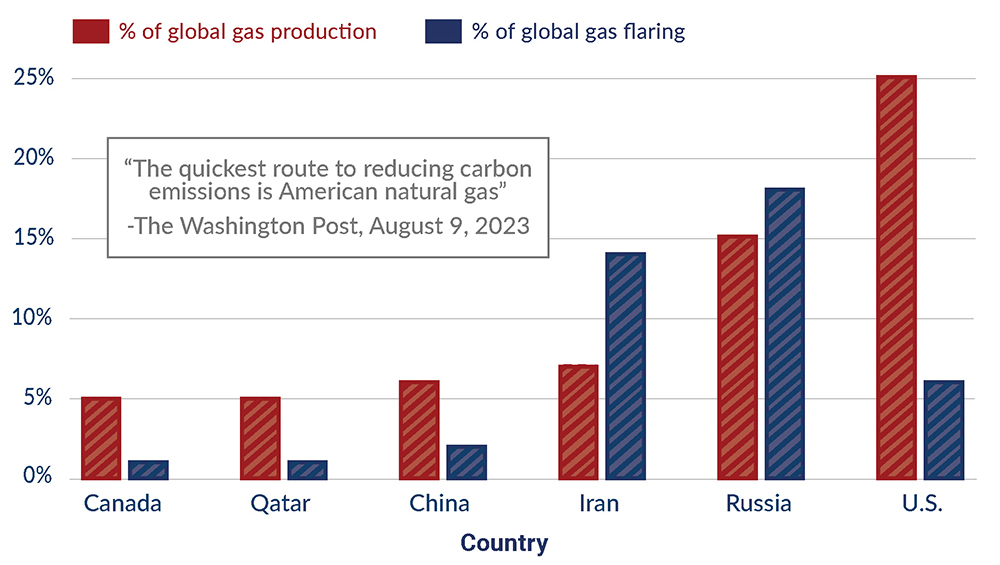
U.S. LNG is among the cleanest in the world and can help lower global emissions, especially in fast-growing economies where energy demand is rising rapidly. In many markets, the real-world choice is between LNG and more emissions-intensive foreign fuels. In those cases, American LNG can deliver meaningful emissions benefits while improving energy security.
A growing body of research from organizations such as the International Energy Agency, S&P Global, Wood Mackenzie and National Energy Technology Laboratory shows the emissions benefits of U.S. LNG exports. According to S&P Global, bringing approximately 40 million tons per annum (Mtpa) of additional U.S. LNG projects online could reduce global emissions by roughly 324 million tons of CO2e between 2028 and 2040 compared to likely alternative supply sources.
Reliable energy access is also essential to building lower-emission power systems. Natural gas provides dispatchable power that can back up intermittent renewables, meet peak demand and support growing grids. In many regions, such as Asia and Africa, LNG can help enable greater deployment of emerging low-carbon technologies.
Global LNG demand is expected to grow for decades. The question is whether that demand is met by the United States or by alternative suppliers with higher emissions, less transparency or fewer strategic benefits for America and its allies.
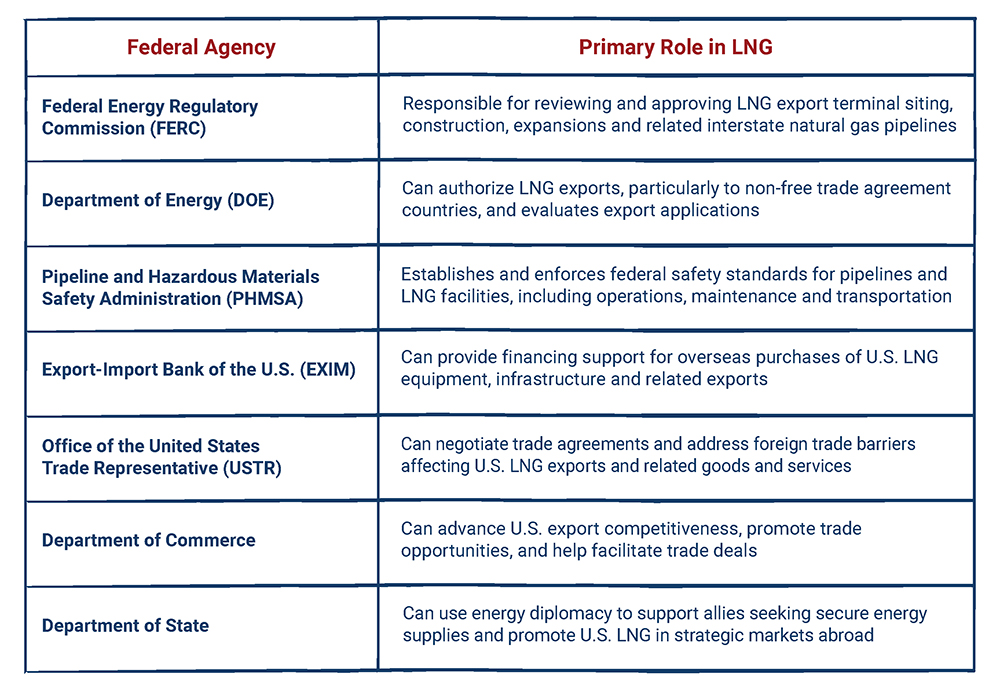
Multiple U.S. federal agencies play important and complementary roles in approving LNG projects, ensuring safety, facilitating exports and advancing U.S. energy interests abroad.
1. Permitting Reform for Energy Infrastructure – Timely, transparent, and predictable permitting is essential for U.S. energy security and leadership, and LNG infrastructure plays an important role by ensuring American energy can reach global markets and meet rising demand. Export terminals are large, capital-intensive projects that often take years to permit and construct, meaning there is significant lead time before new American supply can reach global markets. Federal reviews for LNG terminals, export authorizations and interstate natural gas pipelines should be completed efficiently and transparently.
2. Modernize Pipeline Infrastructure – LNG exports depend on a strong domestic pipeline network capable of safely and reliably delivering natural gas to export terminals. Policymakers should support next-generation pipeline materials, advanced monitoring systems and infrastructure upgrades that improve reliability and allow pipelines to keep pace with rising demand. Legislation such as the Next Generation Pipelines Research and Development Act would expand federal RD&D efforts for advanced pipeline technologies, materials and systems that can strengthen U.S. energy infrastructure.
3. Strengthen Methane Monitoring, Detection, and Measurement – American natural gas is among the lowest emissions in the world, but increasingly, global buyers are requiring verified methane emissions data to access their markets. Nearly 60% of U.S. LNG exports go to countries with methane regulations, and forthcoming requirements in the European Union will require verified emissions data for market access. Without credible measurement tools, U.S. producers risk losing competitiveness in key export markets.
To address this challenge, Congress could use the National Aeronautics and Space Administration (NASA) reauthorization to direct NASA to develop a science-based national strategy to assess current and emerging methane monitoring capabilities. Leveraging NASA’s world-class satellite expertise, in partnership with private industry, can help close critical data gaps, improve the transparency and reliability of methane measurement and strengthen the credibility of U.S. energy exports. A coordinated strategy would help ensure American LNG remains the global standard while reinforcing U.S. energy security, market access and global competitiveness.
4. Expand U.S. LNG Exports Through Strategic LNG Partnerships – The Trump Administration has made historic bilateral LNG agreements with partners such as the European Union and Japan. Initiatives such as the U.S. Trade and Development Agency–U.S. Chamber of Commerce Global Gas Initiative are also helping to expand market access by supporting project development, facilitating partnerships and advancing infrastructure deployment in emerging economies. To build on this momentum, Congress can help translate non-binding commitments into more durable and strategic partnerships. Formal LNG partnerships would create a durable framework to deepen engagement with key regions, involve private-sector buyers and developers, coordinate on emissions data and regulatory standards and leverage tools such as EXIM to support import infrastructure abroad. A more coordinated partnership model, codified by Congress, would strengthen long-term market access for U.S. LNG exporters while advancing our allies’ energy security and American geopolitical leadership.