Posted on August 10, 2026 by Casey Kelly and Will Bryant
America’s electricity grid is the foundation of a modern and growing economy, yet the existing transmission system is rapidly approaching its capacity limits. The rapid rise of domestic manufacturing, the electrification of transportation and industrial sectors and the emergence of Artificial Intelligence (AI) are driving unprecedented electricity demand. At the same time, much of the electricity transmission system is more than 25 years old, and must be upgraded or replaced. Expanding the grid is essential to meeting growing demand, keeping electricity affordable and ensuring America can outcompete China. Meeting future demand will require both new transmission infrastructure and innovative technologies that can expand the capacity of the existing grid.
Greenfield transmission projects expand the grid by creating new paths that move electricity from new and remote generation sources to load centers. They are critical for unlocking remote resources, such as geothermal, and for enabling new power plants, including advanced nuclear reactors, to deliver power to the grid. But historically, many of these projects have taken a decade or more to complete due to barriers related to permitting, siting, cost allocation and litigation.
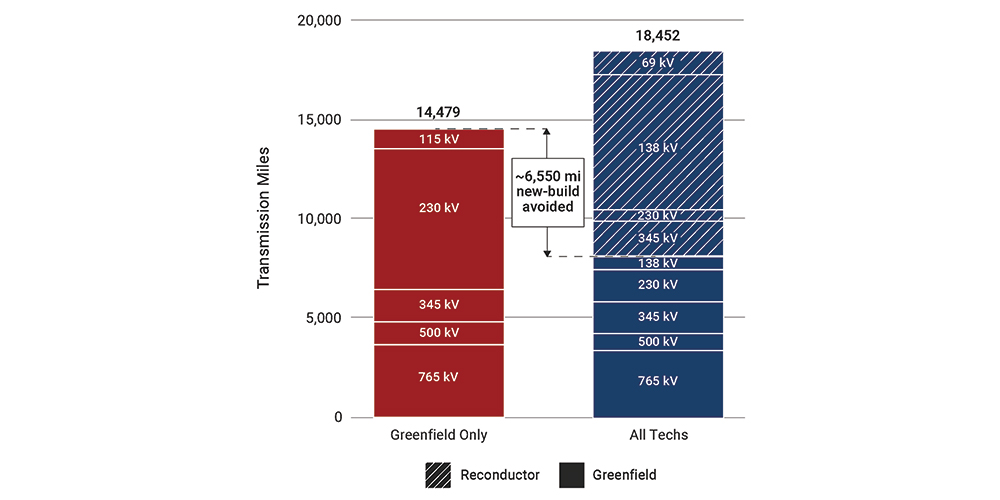
As a result of these challenges, increasing attention is paid towards innovative grid technologies that can unlock more capacity on existing infrastructure faster and at a lower cost than greenfield development. This suite of technologies includes conductors with higher ampacity, or current-carrying capacity, that replace existing wires to increase power transfer over existing transmission paths. However, these technologies are underutilized due to their perceived risk, misaligned investment incentives and limitations in today’s transmission modeling tools.
Existing transmission software models can either plan for the long-term future of the grid or determine whether the system can operate reliably under worst-case conditions, but not both at the same time due to computational limitations. This means that existing models cannot optimize transmission expansion while also accounting for engineering and reliability constraints. As a result, long-term planning frameworks can’t evaluate the cost-optimal mix of transmission expansion options – like greenfield transmission, reconductoring with high-ampacity conductors, or deployment of other innovative grid technologies – to meet growth while maintaining reliability.
To address these analytical limitations, Evolved Energy Research (EER) developed a proof-of-concept integrated transmission model that bridges the gap between capacity expansion and power flow modeling. Using the Electric Reliability Council of Texas (ERCOT) system as a test-bed, this report finds that an integrated modeling approach is both a possible and powerful means to identify the opportunity and role for high-ampacity conductors and high-voltage transmission to meet surging demand reliably and affordably.