Posted on April 30, 2026 by George Smith
Speaking before a joint session of the United States Congress this week, King Charles III delivered a pointed message: “Our alliance cannot rest on past achievements.” Nowhere is that more true than in energy. The next chapter of the U.S.-UK relationship is being written right now, not in ink, but in megawatts, reactor designs and critical mineral supply chains.
Last September’s Atlantic Partnership for Advanced Nuclear Energy was a watershed moment. Not just another diplomatic communiqué, but a commitment to American energy dominance and British industrial revival. By targeting a reduction in reactor licensing timelines from four years to two, the U.S. and UK are finally removing the regulatory anchors that have held back private capital from nuclear for decades.
U.S. companies have already responded:
These projects are more than infrastructure; they are early signals of a deeper alignment. They prove that American energy leadership depends on a simple, relentless operating model. Innovate fast, build here and sell into global markets.
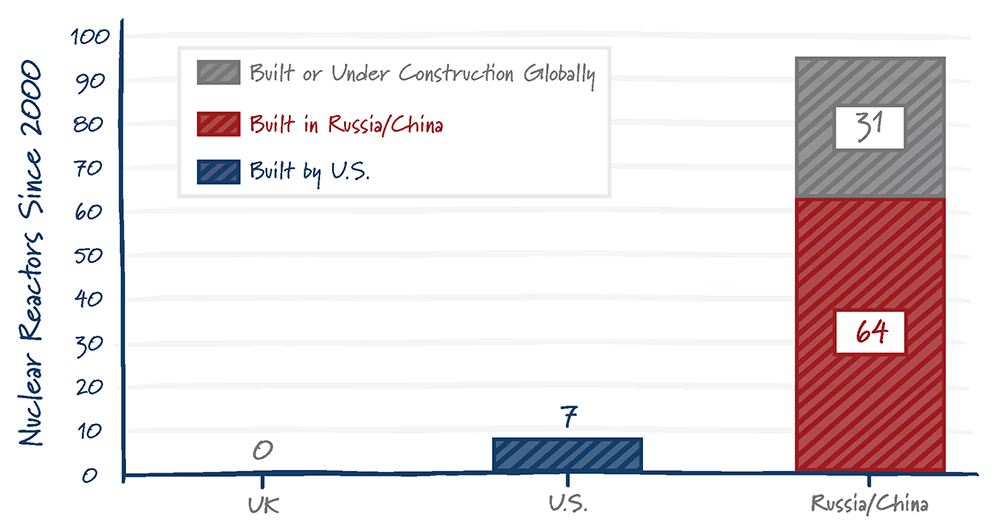
Innovation is important, and the U.S. and U.K. are some of the best at it. But ultimately, leadership is measured in what gets built. The nuclear race is a zero-sum game. Since 2000, Russia and China have built 64 reactors just in their own countries, with another 31 either built or under construction around the globe. In the same time, U.S. companies have built seven, and the U.K. has built none. Every reactor sale locks in a strategic relationship for up to a century. If the U.S. and UK don’t lead, Beijing and Moscow will.
China and Russia Are Winning the Global Reactor Race
Source: Internal ClearPath Tracking
China’s massive state subsidies and standardized designs have already made it the partner of choice for many developing nations. That does not mean that we need to out-subsidize China; we can out-innovate. The U.S.-UK partnership offers a credible alternative. Better technology, greater transparency and the backing of the world’s two most mature capital markets, dynamic private sectors and trusted nuclear regulators. That’s a compelling case, but only if American firms can compete on financing and speed, not just technology.
The Atlantic Partnership and other complementary efforts like the U.S.-UK Critical Minerals Memorandum of Understanding signed in February 2026 are strong starts, but frameworks without permanent legal architecture can be unwound. The next logical step is a formal energy security agreement with the U.S.-UK trade framework solidifying energy at its core.
As King Charles III reminded Congress this week, quoting President Lincoln, “the world may little know what we say but will never forget what we do.” 250 years ago, America declared independence from Britain. Now both nations have the chance to declare something new. Share independence from global energy volatility. That declaration won’t be signed with a quill. It will be built by American companies, in allied markets, locked in by the permanent legal architecture that no future administration can quietly unwind.