Conservatives Lead with Rational Environmentalism at COP27

The 27th Conference of Parties (COP27) was held in Sharm El-Sheikh, Egypt, where delegates from across the world gathered to share ideas on how to tackle the global climate challenge, but this time with conservatives offering real solutions to reduce emissions globally by innovating here in the U.S.

The Conservative Climate Foundation (CCF) and a Congressional delegation (CODEL) of six Republican Members of Congress attended COP27 to engage in discussion around climate issues — and bring a conservative viewpoint supporting the economy and the environment. While in Sharm-El Sheikh, several of these Republican Members took the stage at the U.S. Pavilion to discuss “rational environmentalism,” and how conservatives fit into the global conversation on climate and clean energy. Specifically, they articulated a vision for policy solutions they intend to lead with, including increasing innovation and making clean energy more affordable.

The Members agreed that the climate is changing, global industrial activity is contributing, and there is a lot of work to be done in the clean energy space to address this challenge. But, most importantly, they stressed that we need to take action in a way that makes political and financial sense, allowing our economy and national security to thrive.

Rep. John Curtis (R-UT), chair of the 73-member Conservative Climate Caucus, emphasized the fact that Republicans deeply care about environmental issues and are eager to work towards bipartisan solutions, despite the fact that the world has been led to believe that they are ignorant in this area.

“My district has a unique component that I think all conservatives share,” said Rep. Curtis. “They care deeply about the land we inherit from our fathers and mothers. They care deeply about leaving it better than they found it. Yet ironically, we’ve been branded as not caring about the environment. Why? Because we push back on the litmus test and extremism of ideas that take the head off to fix the headache.”

The “rational environmentalism” approach discussed by the CODEL has been ignored by much of the media and their political opponents. Rep. Garret Graves (R-LA), who serves as the Ranking Member on the Select Committee on the Climate Crisis and leads the Energy, Climate and Conservation Task Force, stated the importance of making gradual changes and ensuring that the U.S. can move forward with clean energy in a common-sense fashion that includes a wide portfolio of energy sources.

“I think what’s most important is taking things into bite-sized pieces. Let’s talk about redesigning the grid to be able to handle distributed generation. Let’s talk about investment in resilience. Let’s talk about concepts for conservation and energy efficiency where you actually reduce the cost of energy consumption for residential and commercial consumers. Bringing down costs of building products in your country, therefore improving competitiveness. There are many, many things where, if we break it into bite-sized pieces, we’re all on the same page and we can find solutions that are actually cost-effective,” explained Rep. Graves.

Rep. Dan Crenshaw (R-TX) pivoted the conversation to discuss the national security advantages of investing in clean energy here in the United States. Maintaining American leadership over China is an important pillar of the conservative climate agenda.

“70% of solar panels are made in China, the vast majority of processing for various minerals is in China. China is not friendly to us; they’re the world’s biggest emitter,” said Rep. Crenshaw. “We should be honest about the carbon footprint of buying these things manufactured in China. Prosperity, energy security, and clean energy are the goals.”

Rep. Mariannette Miller-Meeks (R-IA) highlighted community benefits of investing in emissions reduction technology. As a Representative of a large agricultural district in Iowa, she noted the value of innovative agricultural practices for both the climate and her home state’s economy.

“When you look at what we’re doing in the agricultural space, it has a huge contribution, not only on conservation, but on energy production,” explained Rep. Miller-Meeks. “It’s really amazing what the agricultural sector is doing to reduce carbon emissions, replenish soil and water quality, and also providing liquid fuels as well as food for the globe.”

The bottom line: Conservatives not only have a seat at the table when it comes to climate and clean energy, they have ideas and a strategy ready to implement in the next Congress focused on reducing global emissions while keeping America’s economy strong.

CCF’s CODEL included:

ClearPath is a founding member of CCF, a 501(c)(3) nonprofit organization that aims to educate lawmakers and the public about reducing emissions with common-sense, economically feasible solutions based on conservative principles.
Clean Energy Infrastructure Year Marches On

November 2022 marks the first anniversary of the bipartisan Infrastructure Investment and Jobs Act’s (IIJA) robust investments in energy demonstration projects. This law, and its forerunner the Energy Act of 2020, both earned broad bipartisan support to invest in American infrastructure innovation and pave the way for America to once again lead the world in breakthrough clean energy technologies.

With great investment comes great accountability. ClearPath has been actively tracking the programs authorized by the Energy Act of 2020 and funded through the bipartisan infrastructure law. These investments include more than $62 billion in energy programs at the Department of Energy (DOE). The majority of these programs are located in the new Office of Clean Energy Demonstrations (OCED), which received more than $21 billion in funding through the IIJA. ClearPath provided implementation recommendations for key demonstration programs that will be critical for innovative new technologies including advanced nuclear, carbon capture and storage, hydrogen hubs, enhanced geothermal systems, and critical mineral production to reach commercial viability. Continued engagement with the private sector will be essential to ensure these programs are structured for success in these critical public-private partnerships.

Over the course of the first year, the Department has taken the initial steps, including receiving public comments and stakeholder feedback, to stand up dozens of new programs. ClearPath has helped facilitate stakeholder discussions with utilities, oil and gas companies with carbon capture expertise, and hydrogen developers. The Department has been measuring progress through issuing Requests for Information and Notices of Intent for $32 billion worth of programs, but has yet to open competitive application periods for the majority of these programs, including the much-awaited Direct Air Capture and Carbon Capture Hubs programs. Major funding opportunities, like the Hydrogen Hubs and civil nuclear credit programs, currently have open application periods. Over the course of 2023, it is likely that the vast majority of the remaining programs will see both application periods and award selections.

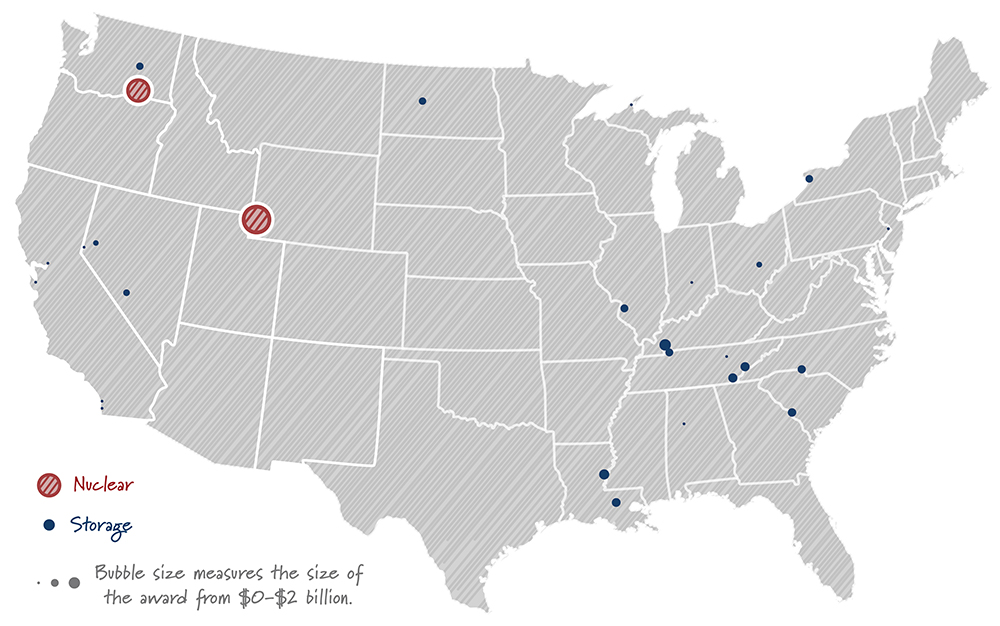
The Department has announced the recipients for two major demonstration programs: The Advanced Nuclear Demonstration Program was partially funded through the bipartisan IIJA to provide more than $3 billion to projects located at two sites including the Terrapower project in Kemmerer, Wyoming and the X-Energy Reactor project in Richland, Washington. Additionally, the Department announced $2.8 billion from the Battery Manufacturing and Recycling Grant Program to support more than 20 projects located in more than a dozen states. These projects are designed to boost domestic capabilities across the battery supply chain, including commercial-scale facilities to process lithium, graphite and other battery materials, manufacture components, and demonstrate new approaches like manufacturing components from recycled materials. Done correctly, these projects will increase America’s competitiveness with China on critical minerals.

IIJA Award Selections to Date

In the new Congress, oversight related to the bipartisan infrastructure law will become an increased focus for both Chambers. While Congress will be interested in where the funds are being allocated, it will be equally important to understand structural challenges at the Department. One major challenge is hiring the necessary staff for the OCED to support these new programs and billions in federal funding. Additionally, Congress has yet to confirm nominees for the Underscretary for Infrastructure or a permanent Office director for OCED, although David Crane, the Infrastructure nominee, recently participated in his Senate confirmation hearing.

When it comes to oversight, it will be critical for policymakers to acknowledge the intent of these demonstration programs. While many will reflect past public failures that received federal funds, namely Solyndra, the reality is that demonstration projects are intended to be more like a test run than a final product. But the opportunities for success are greater, with companies and projects including Tesla and Vogtle that received early funding from programs offered by DOE having reached commercial status. By allocating these federal funds, DOE is absorbing risk the private sector would otherwise be unable or unwilling to take on. Much like the private sector investing in new technology, part of this risk will mean not every project succeeds. The critical piece will be to ensure this is part of the innovation cycle and not exacerbated by political interference.

This is where productive and robust congressional oversight can play an important role to protect taxpayer dollars and improve future research and demonstration projects for the next era of American innovation. While it is still early in the process for the major funding investments provided by the Energy Act of 2020 and the bipartisan infrastructure law, the first year past enactment has laid the groundwork for major announcements in the year ahead. ClearPath will continue to track these programs, award announcements, and the flow of federal funds through our Infrastructure Tracker Dashboards.

Conservative Climate Solutions on the Global Stage

With a new Congress on the horizon, what’s next for climate policy is top of mind for many – but America isn’t the only country with climate in the spotlight this fall. From November 6-18, delegates from all over the world are gathering in Egypt for the annual Conference of the Parties (COP) to discuss solutions for lowering carbon emissions around the world.

Since the first COP meeting in Berlin, Germany in 1995, member nations, or Parties, have been meeting on a nearly annual basis to discuss global climate action. This year, at the 27th conference in Sharm El-Sheikh, Egypt, the Parties are focusing on taking actions to address the effects of climate change, including reducing carbon emissions and building more resilient communities around the globe.

ClearPath is a founding member of the Conservative Climate Foundation (CCF), a 501(c)(3) nonprofit organization that aims to educate lawmakers and the public about reducing emissions with common-sense, economically feasible solutions based on conservative principles. Last year, CCF brought a first-of-its-kind Congressional delegation (CODEL) of four House Republicans to COP26 in Glasgow, Scotland, and this year, CCF is arriving with a larger delegation in Sharm El-Sheikh.
CCF’s 2022 CODEL includes:

  • Rep. Dan Crenshaw (R-TX)
  • Rep. John Curtis (R-UT)
  • Rep. Garret Graves (R-LA)
  • Rep. Mariannette Miller-Meeks (R-IA)
  • Rep. Greg Murphy (R-NC)
  • Rep. Tim Walberg (R-MI)

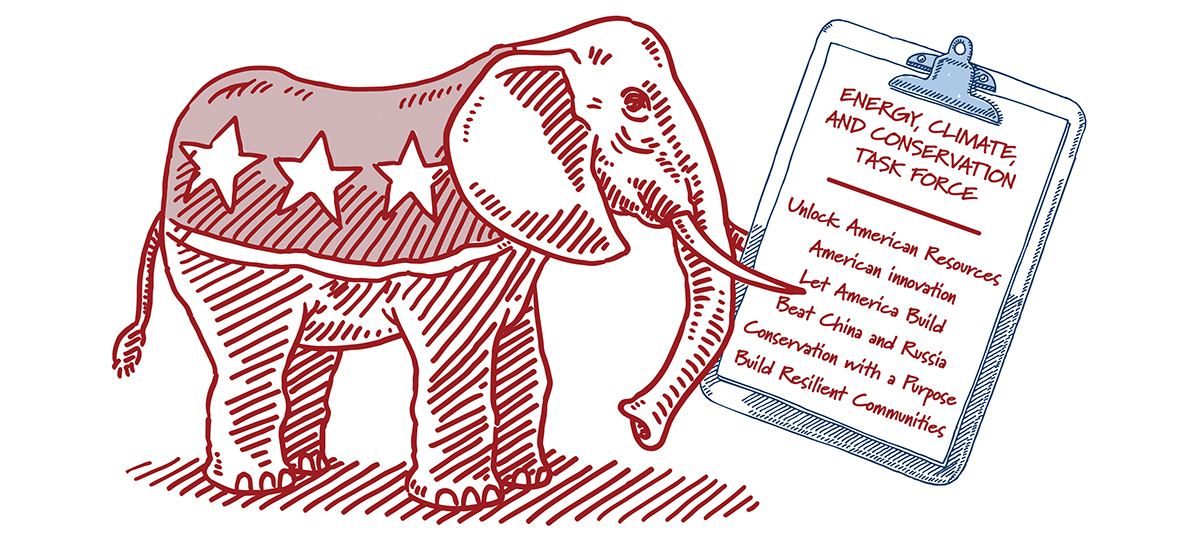
Several of these Members are part of the House Energy, Climate and Conservation Task Force, which has rolled out a policy agenda focused on leveraging American innovation, modernizing permitting, unlocking American resources, restoring global energy leadership, building resilient communities, and utilizing natural climate solutions. The Members will also have an opportunity to showcase this plan before the Conference when they take the stage at the U.S. Center within COP27 on November 11.

Nearly all members of the CODEL are also part of the 73-Member Conservative Climate Caucus. The Caucus works to educate House Republicans on climate policies consistent with conservative values and bring more Republicans to the table on solutions that will support our economy, American workers, and national security.

By shifting the conversation and amplifying conservative voices on climate, we can find durable, bipartisan solutions to the climate challenge – not just in the U.S., but on the global stage.

ClearPath’s Clean Energy Innovation Academy Brings Congressional Staff to Illinois

Energy independence is American independence, and research, development, and deployment of American-made clean energy technologies are necessary for getting us there. The U.S. has an abundance of energy resources, and exciting opportunities lie ahead.

Americans are hard at work developing clean energy technologies here at home. Scientists and engineers at the Department of Energy’s (DOE) National Laboratories as well as private energy companies are making strides in nuclear and other clean energy technologies.

Illinois, home to Argonne National Laboratory and Braidwood Nuclear Generating Station, was the perfect first stop for ClearPath’s Clean Energy Innovation Academy (CEIA). CEIA, launched in 2020, is an ongoing educational series for Congressional staff focused on conservative clean energy technology and policy. We were thrilled to bring a delegation of 10 Congressional staff to Illinois for this year’s CEIA educational trip to explore two exciting facilities accelerating research, development, and operation of American clean energy technologies. The delegation included staff who work for Members on the House Science, Space & Technology, House Energy and Commerce, House Ways and Means, Senate Appropriations and Senate Finance Committees as well as the Congressional Western Caucus.

These staff joined us to expand their understanding of innovations in the American clean energy industry that will make the global energy transition cheaper and faster. While in Chicago, we had a packed schedule of educational events, including these highlights:

Braidwood Nuclear Generating Station

Our first stop was Braidwood Nuclear Generating Station in Braceville, IL. Braidwood is a two unit 2,389 MW nuclear power plant owned and operated by Constellation Energy. The facility powers about two million homes and employs nearly 700 employees southwest of Chicago.

While there, the Congressional staff visited several parts of the plant to understand how the site’s twin reactors produce electricity. Highlights included the two turbine-generators converting the plants steam into electricity, the main control room at the heart of the plant, and the spent fuel pool which stores fuel after powering the reactor. Braidwood staff answered numerous questions on how the plant operated, inspections and maintenance, what different dials and switches do in the control room, and the different kinds of jobs at a nuclear plant.

Stations like Braidwood are America’s clean energy workhorses, producing zero carbon dioxide emissions as they operate. According to the 2021 report Clear Path to a Clean Energy Future, maintaining existing nuclear reactors is one of the cheapest ways to help meet utility commitments to reduce carbon emissions.

Unfortunately, a lot of development of nuclear technology – a crucial technology for reducing emissions – is done outside of the U.S. In fact, only 2 out of the 52 nuclear reactors currently under construction across the globe are American reactors. But thankfully, there is an exciting wave of next-generation reactors going through the design process today.


Argonne National Laboratory

The delegation also visited Argonne National Laboratory, America’s first national lab, established in 1946 as part of the Manhattan Project. Argonne is a multidisciplinary science and engineering lab with unique capabilities and world-class facilities.


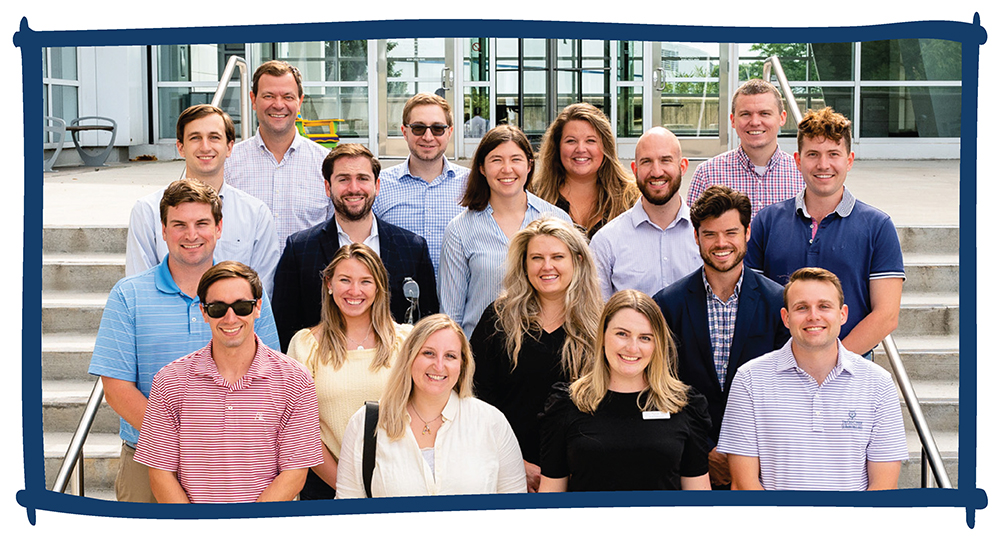
Front Row L to R: Daniel Dziadon, Amanda Sollazzo, Emily Johnson, Greg Warren
Second Row: Parker Bennett, Kalyn Swihart, Hannah Anderson, Tommy Reynolds
Third Row: Ryan Mowrey, Jake Bornstein, Casey Kelly, Niko McMurray, Grant Cummings
Back Row: Luke Bolar, Alex Fitzsimmons, Ashley Higgins, Mike Davin

Photo Credit: Mark Lopez, Argonne National Laboratory

As part of the visit, the delegation toured the Materials Engineering Research Facility, which develops economically viable processes to enable private-sector commercialization of advanced materials for various purposes, including advanced energy storage. Staff also visited Argonne’s Leadership Computing Facility, home to some of the world’s fastest supercomputers, including the forthcoming exascale computing system, Aurora. Upon completion in 2030, Aurora will apply machine learning and other advanced computing techniques to enable deeper insights into scientific disciplines ranging from physics to materials science to clean energy technologies.

In addition, the delegation toured Argonne’s Center for Nanoscale Materials and Advanced Photon Source, two of the lab’s world-class user facilities that partner with industry to push the boundaries of scientific discovery and technology commercialization.

Additional briefings were provided by Oklo Inc., an advanced nuclear reactor startup, and Antora Energy, a group working to electrify heavy industry with thermal energy storage for zero-carbon heat and power.

ClearPath looks forward to continuing its Clean Energy Innovation Academy in 2023.