Nebraska’s Agricultural Innovation: Biochar, Precision Management & Biochemicals

American farmers have a long history of using innovation to solve problems at hand. In 1793, Eli Whitney invented the cotton gin. In 1837, John Deere invented the steel plow. In the 1940s, Norman Borlaug figured out how to increase crop yields. In 1989, satellites were used for precision agriculture. 

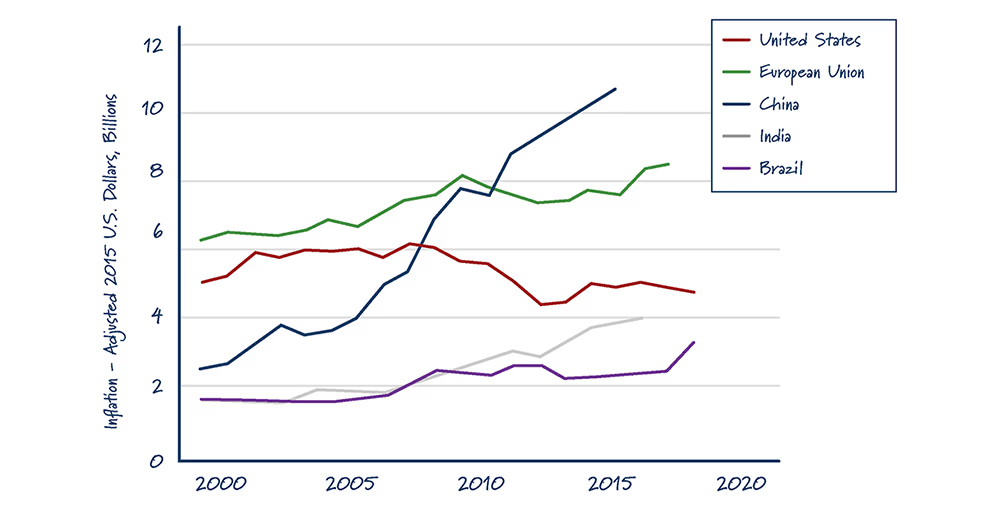
While American agriculture was once defined by breakthrough innovations, over the past 20 years, public investment in U.S. agricultural R&D has declined by over 30%. During that same period, China’s investments in agricultural R&D surged, spending double that of the U.S. by 2015. Brazil and India have also ramped up efforts, with Brazil spending nearly double the U.S.’ share of agricultural GDP on R&D.

Public Agricultural Research and Development Investments: U.S. and other countries
It is time for America to reclaim its mantle of innovation in agriculture. Regions like the Midwest are growing hubs for agricultural innovation, and farmers are employing high-tech equipment and techniques to increase yields, reduce inputs, and reduce emissions.

In June, ClearPath visited a series of cutting-edge sites in Nebraska, spanning ag-tech, commercial biochemical manufacturing, and interdisciplinary research, that are enhancing rural prosperity. From on-farm automated crop sensors to biochemical start-ups, these facilities represent America’s leadership in agricultural innovation.
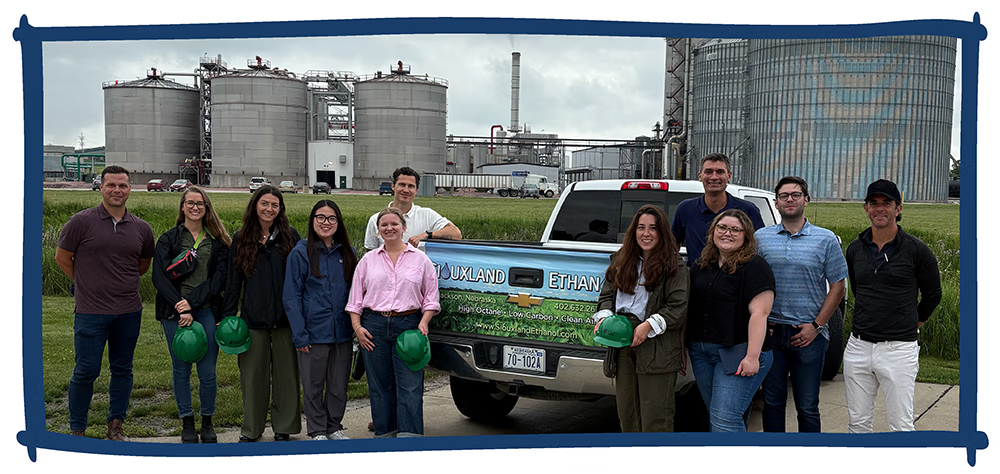
Members of the ClearPath, American Conservation Coalition (ACC), and Conservative Coalition for Climate Solutions (C3 Solutions) teams at Siouxland Ethanol, where Bluestem’s Project Heartland will be located.


Federally Supported Agricultural R&D Paves the Way for Innovation

Across the University of Nebraska–Lincoln (UNL) campus, researchers are building agricultural tools and perfecting practices, with farmers’ needs at the forefront and an eye towards commercialization.

The Eastern Nebraska Research, Extension and Education Center (ENREEC) is an integral hub of research and innovation. It covers 9,500 acres and meets the needs of Nebraska’s rural sector through research and Nebraska Extension. We visited and learned about:

We also visited two prominent research labs at UNL that showcase the value of innovation and farmer engagement in addressing agricultural challenges:

Continued federal support can complement these on-the-ground efforts in Nebraska and across the U.S. Examples of past legislation introduced in Congress that could support agricultural R&D include:


Pioneering Bio-Based Chemical Manufacturing in Nebraska

Across Nebraska, a cluster of companies is reimagining the future of industrial production through bio-based technologies that reduce emissions, strengthen rural economies, and scale clean energy solutions.

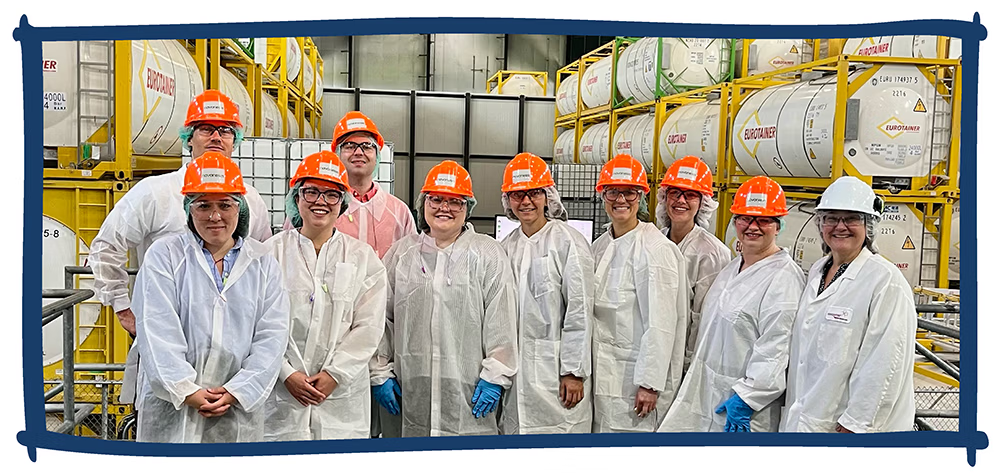
ClearPath, ACC, and C3 Solutions at Novonesis.

Projects like these have an opportunity to cement America’s energy and agricultural dominance in the coming decades. The recently introduced bipartisan Agricultural Biorefinery Innovation and Opportunity (Ag BIO) Act of 2025 aims to foster precisely these pioneering efforts, providing critical federal support for innovations taking root.


The Road Ahead

Nebraska is redefining what it means to lead in innovative agriculture. These facilities are demonstrating that cutting-edge technologies can be deployed today, through both start-up and commercial scales.

Whether deploying precision nutrient management tools, turning corn into biochemicals, or growing new markets for bio-based materials, Nebraska’s ecosystem blends scientific expertise with practical applications on the ground. And in doing so, it’s charting a clear path for how rural economies can thrive with more agricultural innovation.


Fusion 101

Sizing Up Energy Storage: The Grid Storage Launchpad Is Here

In August of 2024, the Department of Energy (DOE) dedicated the Grid Storage Launchpad (GSL) at the Pacific Northwest National Laboratory (PNNL). Years in the making, the $75 million GSL is now among the foremost storage research and development (R&D) facility in the country to accelerate the development of next-generation storage technologies. This facility is a testament to the world-class American energy innovation apparatus. This unique structure leverages DOE and the national labs to spur public-private partnerships that can deploy innovative technologies to boost grid reliability and reduce costs.

DOE first identified PNNL as the site for the GSL in 2019, followed by a larger announcement from then Energy Secretary Dan Brouillete in 2020. The GSL and the Energy Storage Grand Challenge both received support from former President Donald Trump in his proposed presidential budgets for FY2020 and FY2021. 

The overarching goals of the GSL are supported by the bipartisan Better Energy Storage Technology (BEST) Act authored by Senators Susan Collins (R-ME), Martin Heinrich (D-NM) and Tina Smith (D-MN) on the Senate side, Bill Foster (D-IL), Jaime Herrera Beutler (R-WA), Sean Casten (R-IL), and Anthony Gonzalez (R-OH), and ultimately signed by former President Trump.The BEST Act received bipartisan, bicameral support, advancing out of the Senate Energy Committee and House Science Committee respectively with 23 co-sponsors in the Senate and 102 co-sponsors in the House. The bill was ultimately included in the Energy Act of 2020 and signed into law by former President Trump.

The BEST Act authorized the Department of Energy (DOE) to establish a cross-cutting energy storage system research and development program to improve the efficiency of the nation’s electric grid, while helping to align research efforts on energy storage technologies. These programs were subsequently funded to the tune of $500 million in the FY23 funding package, directing key resources to the DOE Offices of Electricity, Science, and Energy Efficiency and Renewable Energy.

The BEST Act is a step toward modernizing the U.S. energy grid by promoting American innovation for advanced storage technologies. The bill directed DOE to undertake three energy storage system demonstration projects and established a joint program between DOE and the Department of Defense to demonstrate long-duration storage technologies. It also advanced recycling efforts to reuse critical energy storage materials such as lithium, cobalt and nickel. Collectively, these efforts will help increase the resilience and reliability of the grid, lower energy costs and reduce reliance on foreign adversaries like China. 

Grid reliability is a growing concern all across the country. Grid operators project major increases over the next decade to respond to the growth of data centers, AI and a budding U.S. manufacturing renaissance. From weather events to the retirement of baseload assets, the grid will need a full set of solutions featuring new technologies to meet ever-growing energy demand. For example, wind and solar are variable resources whose availability depends on the weather, which poses challenges to grid operators who must carefully balance supply and demand every minute of every day to keep the lights on. More innovation in storage technology will help with that balance. 

The GSL facility is designed to specialize in the most pressing research areas, including testing basic materials and developing pilot-scale battery systems to validate new technologies. These types of activities are a key part of the innovation S-curve.

There continues to be broad, bipartisan support for energy storage innovation. In addition to the GSL, the Infrastructure Investment and Jobs Act (IIJA) provided funding for demonstration projects and key support for critical minerals innovations. Beyond these projects, the Trump Administration launched the Energy Storage Grand Challenge to ensure America can domestically develop and manufacture the energy storage technologies needed to meet market demands by 2030. Most recently, the Biden Administration launched the Long Duration Storage Shot, which aims to “reduce the cost of grid-scale energy storage by 90% for systems that deliver 10+ hours of duration within the decade.” 

This strong federal support and broad public-private partnerships have catapulted energy storage as an innovation success story. These types of agreements can jumpstart innovation from the lab to commercial success. 

Form Energy recently announced projects with utilities in Minnesota and Maine, in addition to nearing completion of their flagship factory at a former steel mill site in Weirton, WV. Quidnet recently received a SCALEUP Award from ARPA-E, and startups Antora and Rondo recently announced major fundraising rounds for their respective thermal battery technologies.

Even though the innovation these companies have put into action, there are still barriers that need to be overcome for broad deployment. These include reforms to wholesale electricity markets to ensure storage assets are compensated for the attributes they provide to the grid, market signals that encourage variable renewables to pair their output with energy storage to provide firm power, and improved models to incorporate long-duration storage into utility planning. 

There is a lot of room for Congress to build on the success of the GSL, the BEST Act and the infrastructure law in the year ahead. These promising investments are just the beginning of a generational shift toward American made storage technologies.

Clean Energy Innovation Academy Brings Congressional Staff to Washington State

To maintain American energy independence, reduce emissions and meet growing electricity demand, it is critical the U.S. leads in the development and deployment of innovative technologies. Exciting companies deploying nuclear fission and fusion, carbon capture and storage, carbon dioxide removal (CDR), hydropower and long-duration energy storage are all on display in the Northwestern U.S., making the region a perfect location for ClearPath’s third Clean Energy Innovation Academy (CEIA) trip for Congressional staff. CEIA, launched in 2020, is an ongoing educational series for Congressional staff focused on conservative clean energy technology and policy.

From Left to Right: Dr. Steven Ashby, Chrissy Harbin, Luke Bolar, Luisa Smith, Jake Kincer, Amanda Sollazzo, Eric Gustafson, Molly Ross, Jeremy Harrell, Emily Johnson, Dillyn Carpenter, Stacey Daniels, Ryan Mowrey, Ashley Higgins, Brian Hughes, Savvy Bowman, Dr. Jud Virden

ClearPath, along with eight Senate staff, consisting of legislative and communications staff who work for Members of the Appropriations, Energy and Natural Resources, Environment and Public Works, and Finance Committees were able to visit companies and research facilities working on nuclear fission and fusion energy, long duration energy storage, carbon capture and utilization, energy analytics and marine carbon dioxide removal.

“Being able to see firsthand how the policies we work on, on Capitol Hill, translate to people on the ground was really impactful. The trip highlighted how important it is to maintain relationships with stakeholders who are charged with providing affordable and reliable energy while ensuring the U.S. remains a leader in energy production, research, and environmental stewardship,” said Ashley Higgins, Senior Energy Policy Advisor. “Whether it’s actual power being generated like we saw at Energy Northwest or the research being done at our National Labs to produce the technologies of the future, it’s clear that we need more of all types of energy to meet current and future demand.”

The Delegation visited the Control Room Simulator at Energy Northwest’s Columbia Generating Station

The delegation toured Energy Northwest’s Columbia Generating Station in Richland, WA —  a world-class nuclear power plant that has been providing reliable baseload power to the region since 1984 and the third largest electricity generator in the state. Staff were able to visit the control room simulator, the turbine building, and reactor building which houses the boiling water reactor and spent fuel pool. Energy Northwest’s CEO, Bob Schuetz, shared their future plans for the facility, including the re-licensing process and the exciting partnership with X-energy to bring an advanced small modular reactor to the Richland site.

The Grid Storage Launchpad at PNNL is a state of the art facility conducting research on energy storage and battery technologies.

The delegation also toured the Pacific Northwest National Laboratory (PNNL) in Richland, one of seventeen Department of Energy national labs. PNNL is an excellent model for public-private partnerships to help bring new technologies to commercialization. Some highlights include the Carbon Capture & Utilization labs, the Electricity Infrastructure Operations Center, the Applied Engineering/Advanced Manufacturing lab and the Grid Storage Launchpad. The latter was completed in 2024 and is advancing the next generation of energy storage and battery technologies. PNNL Lab Director Dr. Steven Ashby, Associate Director Dr. Jud Virden, Executive Director of Communications and Engagement Jaime Shimek, and other key lab leadership were part of the visit.

PNNL’s Marine Science Lab showcases next generation technology to the delegation.

The delegation then visited PNNL’s Marine Science Laboratory in Sequim, WA, the only marine sciences research facility in the Department of Energy’s (DOE) National Lab system. Notably, PNNL is partnering with Marine CDR company Ebb Carbon who captures CO2 in the ocean while also reducing ocean acidity. The PNNL and Ebb Carbon public-private partnership demonstrates the ways that our National Labs work with private industry to research, develop and demonstrate cutting-edge technologies.

The delegation at Helion Energy headquarters in Everett, WA.

The tour concluded with a tour of Helion Energy in the manufacturing hub of Everett, WA. Helion is designing the world’s first fusion power plant and working to demonstrate electricity while scaling up in-house domestic manufacturing to eliminate reliance on international suppliers like China. The Senate delegation saw both the sixth-generation prototype, Trenta, and the construction progress of the seventh-generation prototype, Polaris. Helion believes their fusion technology can lead to the eventual construction of so many power plants that they are referred to by numbers instead of individual names.

In addition to the site visits, the delegation met with representatives from private sector companies Framatome, Stripe, Omya, TerraPower, Twelve and Avalanche Energy, who have operations in Washington State. The topics ranged from the growing trend of bringing clean energy supply chains to the United States, how America has become a CDR innovation hub and the latest advancements in clean energy technologies moving towards commercialization. 

ClearPath looks forward to expanding its Clean Energy Innovation Academy later this year and in 2025 to learn about more clean energy innovation technologies and the policies that will help them succeed. 

CO2 Pipelines Are Safe…and We Need a Lot More

You’ve probably heard about a clean energy technology called Carbon Capture, Utilization, and Storage – or “CCUS” for short.

This is a method of capturing carbon dioxide or “CO2” from emissions sources like power plants and industrial facilities. Another method for reducing emissions is called Direct Air Capture, which removes CO2 that is already in our atmosphere — think a giant vacuum. If we’re serious about global emissions reduction — we need both.

In addition to driving down emissions, captured CO2 is also a valuable commodity.  CO2 is not only used to make your beer fizz, carbon oxides can be used for everyday products like building materials, fertilizer, and fuels. CO2 that is not in use can be permanently and safely stored – usually underground – where it resides for thousands of years. 

Often, when CO2 is captured, it’s not located near an available storage or use site and has to be transported to another location. Today, the best and safest way to move CO2 is through pipelines. 

Pipelines are everywhere – often without us even realizing it. They are beneath our highways, run through our cities, and connect our homes. Other essential resources, like natural gas, water, and waste, are all moved by pipelines. That’s because pipelines are the most land-efficient way to transport materials while minimizing environmental impact.

The Pipelines and Hazardous Materials Safety Administration, also known as “PHMSA”, has long regulated the security of this infrastructure. PHMSA provides national standards for pipeline design, construction, maintenance and operation. These ensure that all necessary measures are taken to mitigate risks and safeguard the well-being of your family and the environment.

Now let’s talk about CO2 pipelines. The U.S. currently has more than 5,000 miles of these pipelines, which have been safely operating across our country for over 50 years. CO2 is a stable, non flammable gas – we know it’s safe. We breathe it in and out every day – it’s even used in fire extinguishers. Over the last twenty years, there have been zero recorded fatalities associated with the very few CO2 pipeline incidents that have occurred. A pipeline accident, like we saw in 2020 in Satartia, Mississippi, while concerning, is extremely uncommon and is not representative of the safety performance of this critical infrastructure over the last several decades.

As demand for clean, reliable, and affordable energy grows, so will the demand for effective carbon management technologies. That means, to meet our energy security and global emission reduction goals, the build-out of CO2 pipeline infrastructure is vital.  An estimated 30,000 – 96,000 miles of CO2 pipelines will be needed by 2050 – that’s roughly 5 to 18 times the length of our existing network. 

We get it, some people are uneasy about new infrastructure. But let’s face it, whether you care about climate change or U.S. competitiveness- we need these technologies. By building CO2 pipeline infrastructure, we are not only building our capacity to reduce emissions and protect our environment, we’re also creating jobs, bolstering local economies, and continuing to use the energy sources that make our country strong. In America, we’re not afraid to build — it’s what we do. 

And, through R&D and innovation, we’ll leverage the efficiency and maintain the strong safety record of this vital American infrastructure.

 Robert Rozanksy

Faith M. Smith

Cole Simons

Justine Ong

Jena Lococo